Life description
life description


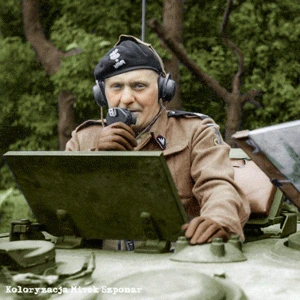
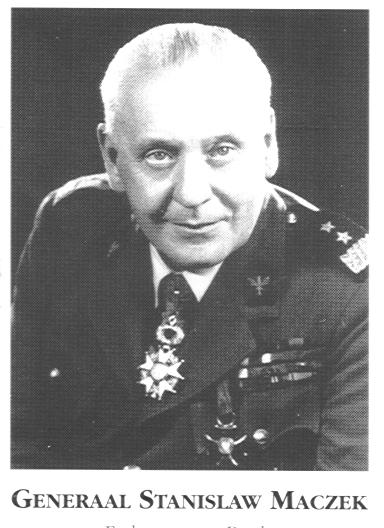 Stanisław Wladysław Maczek was born on March 31, 1892 in the town of Szczerzec near Lwów (Lemberg), Galicia, in the then dual monarchy of Austria-Hungary as the son of Witold Maczek and Anny Czernych. He grew up in a Polish Roman Catholic 'patriotic' family: four sons followed a military career; three, however, will die prematurely. His father was a lawyer, later an appeal judge. It can be said that they were well resourced; people went on an annual winter holiday to Zakopane in the Tatras for a skiing holiday.) After graduating from high school, he studied philosophy, psychology and Polish philology at the Jan Kazimierz University in Lwów from 1910 to 1914.
During the First World War he was mobilized by the Austrian government and deployed as a company commander on the Italian front, among other things. After training and education in Graz, Austria, he was given command of a motorized platoon of the 3rd Landwehr regiment as an Aspirant (ensign) in June 1915. During this period he probably changed his career plans from academic to military, the reason may be that the war would probably last longer than 6 months and he was smart but not an intellectual. Mazcek was more practical and liked the soldier's life.)
It is also significant that during his studies he became a member of the Polish paramilitary scouts association (Związek Strzelecki), which was founded in 1910 in Lwow. Activities included shooting, skiing, map reading, planning and making tours, political and social interactions. During his Austrian military service he further developed his talent and enjoyed being a soldier and, more importantly, he was successful with it.) In addition, it cannot be ruled out that the changed political situation towards a future independent Poland (with a militarily dominant culture) decision to choose a military career has influenced this versus an academic career. In 1919 and 1920 he was, initially as a lieutenant, later as a captain, of the army of the new Polish republic, first involved in actions against the Ukrainian and later against the Red Soviet army. After the armistice of 1920, his life entered calmer waters. He held staff positions at various units and took various courses.
In 1922 he became a major at the age of 30, with retroactive effect from June 1, 1919. From 1924 to 1927 he attended the Higher Military School in Warsaw. On October 30, 1927, he was promoted to lieutenant colonel and given command of the 76th Infantry Regiment; followed a little later by the 81st Hunters of King Stefan Bathory stationed in Grodno.)4 On June 25, 1928 he married Zofia Kuryś, they would have two children in Poland, Renata in 1929 and Andrzej in 1934, a third child, Magdalena, would be born in Scotland.) In 1938 he was appointed commander of the 10th Motorized Cavalry Brigade (10. Brygada Kawalerii), a fully motorized unit consisting of mounted infantry on motorcycles and trucks, tanks, armored cars, machine guns, artillery, engineers and TD )
During the German invasion in September 1939, he fought in vain against the German superior forces with his 10th Motorized Cavalry Brigade. After the Soviet Union also invaded Poland, Maczek, who was in the Lwów area at the time, was ordered to move to Hungary. There he was interned with his brigade. Of the 3,000 men he started with on September 1, 1,500 managed to cross the border with Hungary fully packed on the afternoon of September 19, 1939. Maczek was fortunate that his family was located with his parents-in-law in Stanisławów, close to him. He made sure that they also went with him. Leaving their equipment behind, with the help of Polish diplomats and a blind eye from the Hungarians, they traveled by train, dressed in civilian clothes, via Yugoslavia and Italy to France.)
In France, he was promoted to brigadier general (generał brigady) by Commander-in-Chief General Sikorski on November 15, 1939, with the task of organizing the Poles gathered there in Coetquidan. To return to Poland with a new army as soon as possible.) In February 1940 he was ordered to form a 'Division Lègère Mecanique'.) In May he took command of the Polish Motorized Light Division (10 Brygady Kawalerii Pancernej / 10éme Brigade de cavalerie blindée), formed from the remnants of his former Cavalry Brigade supplemented with Polish soldiers who had fled from other units and volunteers with a Polish background. ) Southeast of Paris he fought a retreating battle against the German army, which was already lost in advance, between June 13 and 17, 1940.)14 Due to a lack of fuel and ammunition, he was forced to abandon the battle.
 Shortly afterwards, General Maczek was appointed commander of the First Polish Army Corps in Scotland and handed over command of the 1st Polish Armored Division to Brigadier General Klemens Rudnicki on May 20, 1945. In September 1945 he was appointed major general (generał dywizji) and commander of the 1st Polish Corps (in May '45: 128,000 men). After the demobilization of the Polish army in exile in 1947, General Maczek was unable to return to his now a communist homeland (Lwów was now called Lwíw and was now part of the Soviet Union) and he settled with his family in the Scottish capital Edinburgh. There he wrote his memoirs, published under the title "Od podwody do czolga". (From horse cart to tank). Until an old age he had to support himself through simple jobs. He was denied a British pension for political reasons.) The communist government of Poland refused to recognize the role of the Polish fighters in the west; General Maczek was also stripped of his Polish citizenship. Attempts at rapprochement by Jaruselki (1981-89/90) were rejected by Maczek: he did not want his name associated with a communist dictator. Recognition and rehabilitation only followed after the fall of the Wall. November 11, 1990 he was appointed lieutenant general (generał broni) by the government of the new Polish Republic. On his centenary he was awarded Poland's highest award, the Order of the White Eagle. General Maczek died on December 11, 1994 in Edinburgh. He would never return to Poland. He lived to be 102 years old. After a funeral mass in Edinburgh on December 21, the coffin containing the general's body was transported by plane to the Netherlands. On December 23 there was a service in the Grote Kerk in Breda and he was buried at the head of his men in the Military Cemetery of Breda.)
Added:
Daily order no. 40 from the Division Commander France, August 6, 1944. After 4 years we are back in France. We landed on French soil to fight for the Polish cause together with England and America. When we left France in June 1940, our ranks were thinned, our future unknown and we were powerless. Today, after 4 years of work on British soil, we have begun our battle march to Poland. The first stage of this march is again France. But now the circumstances have changed. We come here with a sense of pride in our own strength. We are proud because during the 5 years of war we did not break down and did not lay down our arms. On the contrary , with painstaking and persistent work we created the Armored Division, the first in the history of our army. This division stands today on the battlefield against those who announced to the whole world that we had ceased to exist. We are strong because we have the best equipment of the Allies in our division. We know the value of this equipment and we know how to use it properly. That is physical strength. Moreover, we bring something to the battlefield that Germany does not have today. We bring enormous moral strength. We are fully aware that we are fighting for a just cause and that the first gleam of victory is already visible. And therefore, when we go to the first battle, we will demand an account for the entire 5 years of this war. For Warsaw, for Kutno, for Westerplatte and for hundreds and thousands of defenseless victims who died at the hands of the invader. We will demand accountability for every Polish life the Germans took. However, this does not mean that you should use barbaric fighting methods. Fight like a Polish soldier has always fought in our history. Fight hard but like chivalrous. For our first battle we go with the best Allied divisions. We know our worth and that is why today I wish you, as your commander, one thing: May the Germans pay for the honor of fighting with us with their own blood. And remember one thing everyone. A soldier fights for the freedom of many nations - but he dies only for Poland. We all believe that through our hard work, Poland will rise again!
Commander of the 1st Armored Division MACZEK, Brigadier General
Source:
Maczek Museum
Ewan Mcgilvray: Man of Steel and Honor: General Stanisław Maczek,
Helion&Company Ltd, Solihull, 2012
Stanisław Maczek: Van Paardenwagen tot Tank, Van Ierland Uitgeverij, Breda, 2009
F.S.Kurcz (F. Skibinski) The Black Brigade, Atlantis publ., Harrow, 1943
Zbigniew Tomkowsk: Generał Maczek, Ypsilon sp. ,Warszawa 1994
Piotr Potomski: Generał Broni Sanisław Władisław Maczek(1892-1994), Wydawnictwa Uniwerytetu
Warszawskiego, Warszawa, 2008
Franio Bogdanowicz: 1e Poolse Pantserdivisie vanaf Moerdijk tot de verovering van Wilhelmshaven
en de bezetting van Duitsland, een vertaling, In het Spoor van de Divisie,: nr. 7-8,
uitg. Vereniging 1e Poolse Pantserdivisie Nederland, Breda, 2005-2006
Antoni Grudziński: 1. Dywizja Pancerna, Zarys Historyii Wojennej,nr. 34 Przeglądu Kawalerii i Broni Pancernej,
1964,London
Helion&Company Ltd, Solihull, 2012
Stanisław Maczek: Van Paardenwagen tot Tank, Van Ierland Uitgeverij, Breda, 2009
F.S.Kurcz (F. Skibinski) The Black Brigade, Atlantis publ., Harrow, 1943
Zbigniew Tomkowsk: Generał Maczek, Ypsilon sp. ,Warszawa 1994
Piotr Potomski: Generał Broni Sanisław Władisław Maczek(1892-1994), Wydawnictwa Uniwerytetu
Warszawskiego, Warszawa, 2008
Franio Bogdanowicz: 1e Poolse Pantserdivisie vanaf Moerdijk tot de verovering van Wilhelmshaven
en de bezetting van Duitsland, een vertaling, In het Spoor van de Divisie,: nr. 7-8,
uitg. Vereniging 1e Poolse Pantserdivisie Nederland, Breda, 2005-2006
Antoni Grudziński: 1. Dywizja Pancerna, Zarys Historyii Wojennej,nr. 34 Przeglądu Kawalerii i Broni Pancernej,
1964,London